
Key Takeaways
- Class A CDL allows you to drive large combination vehicles like tractor-trailers and offers broader career options, including long-haul and interstate trucking.
- Class B CDL is for single-unit vehicles like buses and dump trucks, ideal for local routes and daily home time.
- Training time differs: Class A CDL programs are more intensive and take longer to complete than Class B CDL programs.
- Endorsements expand job options:
- Class A: Hazmat (H), Tanker (N), Double/Triple Trailers (T), Combo (X)
- Class B: Passenger (P), School Bus (S), Hazmat (H),
- Class A has higher earning potential but may require time away from home.
- Class B offers easier entry and better work-life balance, especially for municipal or passenger transport jobs.
- Federal ELDT rules apply to both, ensuring standardized training nationwide.
Understanding CDL Training Options
Choosing between a Class A and Class B CDL is not about which one is better. It is about how you want your daily work to look. The license you choose affects the vehicles you drive, the routes you take, and the jobs you can apply for.
What is a Class A CDL?
A Class A Commercial Driver’s License (CDL) allows you to drive the largest commercial vehicles on American roads. This license is required for long-haul transportation and interstate freight movement.
Vehicle types you can drive
With this license, you are permitted to drive:
- Truck and trailer combinations
- Tractor-trailer buses
- Tanker vehicles
- Flatbeds
- Livestock carriers
- Refrigerated trucks
- Car carriers
Depending on state regulations, individuals with this license can typically operate vehicles in lower CDL categories.
Weight and towing requirements
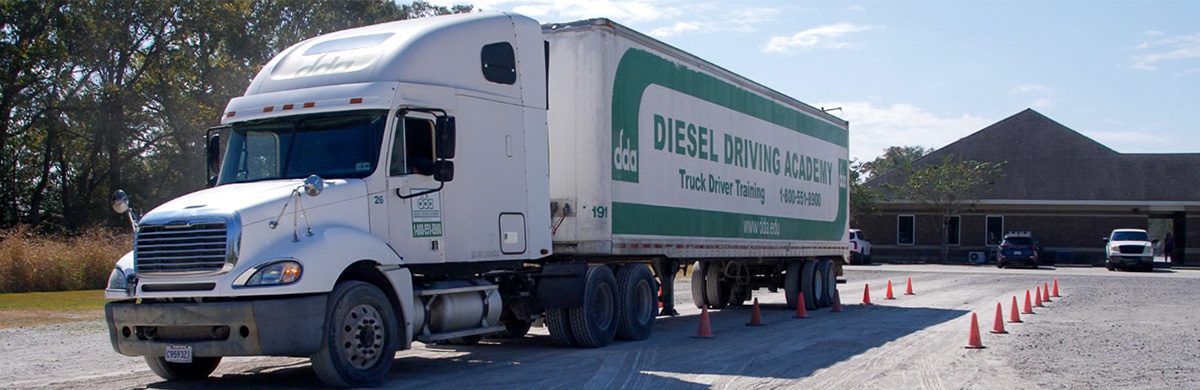
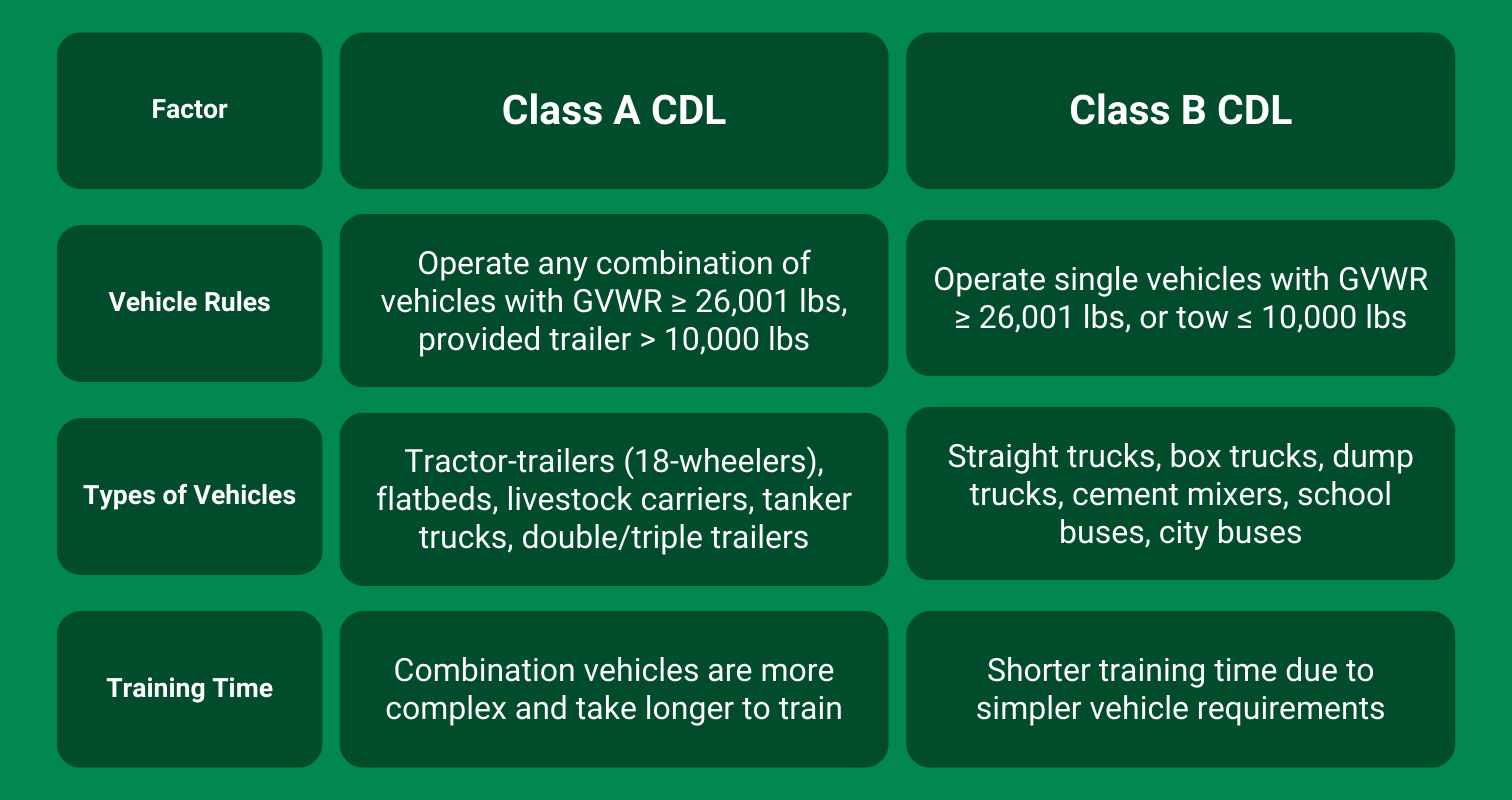
This license is needed for combination vehicles with a gross vehicle weight rating (GVWR) of 26,001+ lbs., towing 10,000+ lb. trailers.
Who should consider a CDL A?
This option is good for those who:
- Want higher-paying trucking jobs
- Seek long-haul opportunities
- Plan to drive various commercial vehicles
- Federal regulations require interstate drivers to be 21+
What is a Class B CDL?
A Class B Commercial Driver’s Licenselets you drive large single-unit commercial vehicles.
Vehicle types you can drive
This license lets you operate:
- Straight trucks (single-unit vehicles)
- City buses, school buses, and tour buses
- Segmented buses
- Box trucks
- Garbage trucks
- Dump trucks
- Cement mixers
- Delivery trucks
CDL B holders can also operate some Class C vehicles, like passenger vans and shuttle buses. With endorsements, they can also drive smaller hazmat vehicles.
Weight and trailer limitations
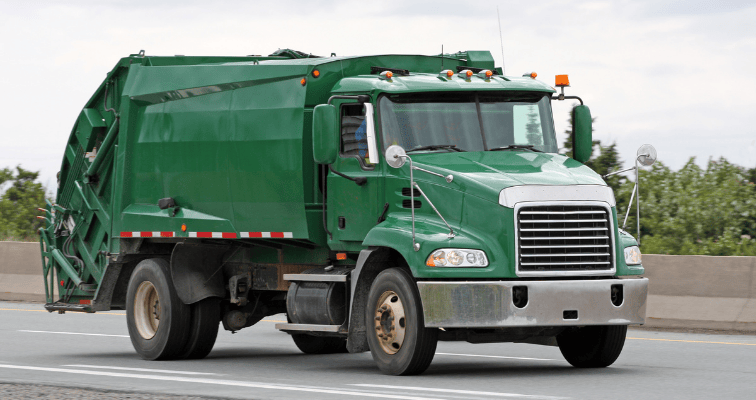
This license is needed for single vehicles weighing over 26,000 lbs with towing up to 10,000 lbs. Most Class B vehicles don’t have trailers, focusing on single-unit vehicles rather than combination vehicles.
Who should consider a Class B CDL
This license is a good fit for:
- Prefer local work over interstate routes
- Want daily home time
- Seek public transportation or municipal jobs
- Want an easier entry into commercial driving
- Are under 21 but want to start driving commercially (inside the state only)
Many Class B jobs involve routes within one area, perfect for drivers wanting a stronger work-life balance. Common roles include bus drivers, delivery drivers, and waste management workers. Training includes classroom and practical components covering vehicle operation, inspections, and CDL knowledge.
CDL Endorsements Explained
CDL endorsements are specialized add-ons that give you additional qualifications and job opportunities. Each requires additional testing through your state’s licensing office.
Common Class A CDL Endorsements (T, H, N, X)
Key endorsements for Class A drivers include:
- T Endorsement (Doubles/Triples): Operating a truck carrying multiple trailers
- H Endorsement (HazMat): Transporting hazardous materials (requires background check)
- N Endorsement (Tank): Operating tanker vehicles
- X Endorsement (Tank and HazMat): Combined tanker and hazardous materials qualification
Common Class B CDL Endorsements (P, S, H)
Class B endorsements focus on passenger transport:
- P Endorsement (Passenger): Operating vehicles carrying 16+ passengers
- H Endorsement (HazMat): Transporting hazardous materials (requires background check)
- S Endorsement (School Bus): builds upon the P endorsement with additional requirements. School bus drivers must pass written and road tests, plus undergo background checks to ensure student safety.
How endorsements expand job options
Endorsements significantly increase employment opportunities in commercial driving. An endorsement qualifies drivers for specialized positions, from transporting hazardous materials to carrying passengers.
These qualifications often lead to higher pay. Carriers offer premium rates for drivers handling specialized cargo or passenger transport, recognizing their added responsibilities and expertise.
Additionally, endorsements provide job security through versatility. During industry-specific slowdowns, endorsed drivers can switch to different transport sectors, maintaining steady employment.
Training Requirements for Class A and B CDL
Proper training is necessary for a commercial driving career. While A and B license training programs share basics, they have differences.
Classroom instruction
The classroom portion covers essential knowledge like vehicle inspections, documentation, and cargo handling. Class A focuses more on combination vehicles, advanced turning, and braking. Class B covers single-vehicle operation and city driving.
Both programs cover regulations, safety practices, and hazard awareness before hands-on training.
Behind-the-wheel CDL training
The driving portions of CDL training also has some key differences:
- CDL A programs teach students how to safely operate tractor-trailers, including coupling and uncoupling trailers, backing, turning, braking, lane control, pre-trip inspection and driving on city streets and highways.
- CDL B programs teach students how to safely operate single-unit vehicles, including turning, braking, backing, managing traffic, and driving in urban and local road conditions.
Both include closed-range practice before supervised road training.
Federal and state regulations
Federal law now requires all new CDL applicants to complete Entry-Level Driver Training (ELDT) from an approved training provider. This applies to first-time applicants, Class-B-to-Class-A upgrades, and those seeking passenger, school bus, or hazardous materials endorsements. States may add extra requirements beyond federal standards.
Pros and Cons of A vs B CDL
Understanding each license type’s benefits helps inform your career choice.
Class A: Flexibility and Long-Haul Jobs
A licenses offer versatility, opening doors to interstate transport and specialized hauling. These positions typically offer higher pay but require extended time away from home.
Class B: Local Routes and Easier Entry
B licenses appeal to those seeking work-life balance, with local routes that allow daily home returns. Training is generally shorter and vehicles are easier to master.
Cost and time investment comparison
Class A CDL programs are more intensive, take a longer time to complete, and cost more than Class B CDL programs.
Job availability and salary differences
Class A licenses offer higher earning potential, especially for specialized roles involving hazardous materials or multiple trailers. Class B positions provide stability, offering consistent schedules and steady demand in community services like public transportation and waste management.
Conclusion
Your license choice depends on your career goals and lifestyle preferences. Class A licenses offer versatility and higher earnings through interstate transport, while a Class B CDL provides better work-life balance with local routes.
Consider how each aligns with your priorities. Both paths offer rewarding careers in transportation, with the right choice depending on your personal and professional goals.
If you’re interested in earning a Class A CDL in Louisiana, Diesel Driving Academy offers ELDT-compliant training programs that can help you get licensed.