
Many people considering a career change have spent years in jobs that no longer reward their effort. In any number of fields, people find the work hard, the ceiling low, and no clear path forward.
For those people, truck driving may be a good option. With high demand, solid pay, and multiple job options, it can offer people wanting a fresh start a terrific opportunity.
Is Truck Driving a Good Choice for Changing Careers?
Yes. Truck driving is one of the more accessible career changes available to working adults. No college degree is required; CDL training can be completed in weeks, and carriers across the country are actively hiring.
Factory workers, warehouse employees, and others in demanding or stagnant roles regularly make this switch. The appeal is straightforward: more pay, more schedule control, and a skill set that travels with the driver.
(Source: American Trucking Associations; Bureau of Labor Statistics)
When the Current Job Stops Working
Most people do not decide to change careers on a good day. The decision usually builds slowly. The raises stop coming. The work gets harder to get out of bed for. The sense that this is all there is begins to set in.
That experience is common across a wide range of jobs. Some of the most frequent starting points for people who transition into trucking include:
- Factory workers who spend years on a production line doing the same repetitive tasks, with limited room to earn more or move up
- Warehouse employees dealing with physically demanding shifts, strict quotas, and schedules that change without notice
- Construction laborers putting in hard hours outdoors with inconsistent work during slower seasons
- Retail and food service workers handling demanding customers and unpredictable hours, often for wages that do not grow
The work is demanding, pay no longer grows, the job is no longer fulfilling, and moving up is rarely an option. When this happens, it may be time for a change.
Trucking works differently. Drivers are skilled professionals in consistent demand, and earnings, schedule, and responsibility all grow with experience.
Starting Over Doesn’t Have to Be Scary
Changing careers can feel risky. Starting a new career means giving up the seniority, routine, or stability a current job provides. A few concerns come up often for people considering this move:
- Am I too old to start over? CDL training regularly attracts people in their 30s, 40s, and 50s. Most carriers have no upper age limit, and life experience tends to make drivers more reliable.
- What if I fail the test? Quality training programs are specifically designed to prepare students to pass, and schools with experienced instructors and smaller class sizes have strong pass rates.
The learning curve is real. So is the payoff. Most career changers who complete CDL training report that the transition was more manageable than they expected.
Why Truck Driving Makes Sense for a Career Change
Job Security
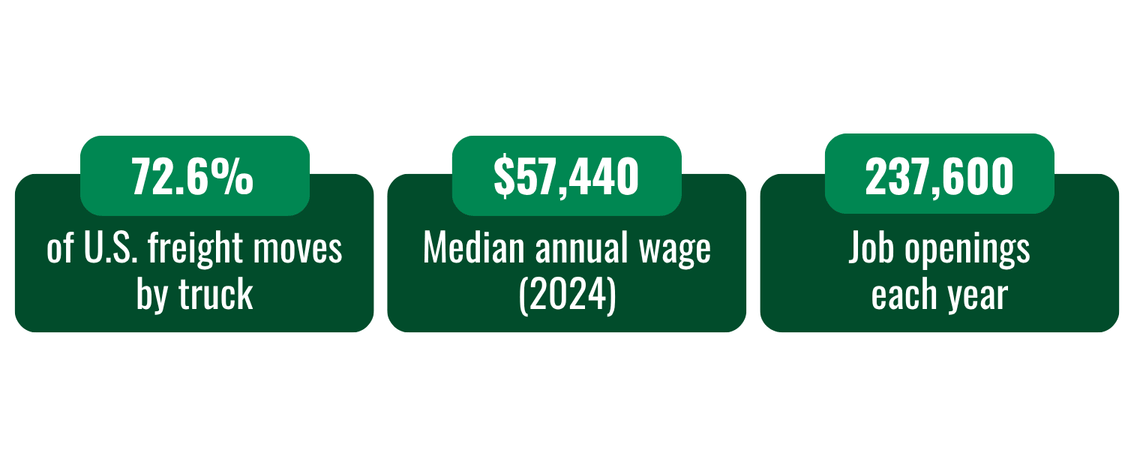
Trucking is one of the more stable industries to enter. The Bureau of Labor Statistics projects 4% job growth from 2024 to 2034, with 237,600 openings per year, driven by freight volume growth and driver retirements rather than economic cycles.
Earning Potential
First-year company drivers typically earn $40,000 to $60,000. The BLS reports median annual wage reached $57,440 in 2024 across the country. For experienced drivers, it’s $76,420, and top earners can exceed $78,800. Pay increases with experience, endorsements, and freight type.
Schedule Flexibility
Truck driving offers schedule options that most traditional jobs do not. Drivers choose the route type that fits their life. See the Route Types section below for a full breakdown.
CDL Requirements
Requirements vary by state, but in Louisiana drivers must:
- Valid standard driver’s license
- At least 18 years old (21 or older to drive commercially across state lines)
- High school diploma or GED
- Clean driving record
- Pass a DOT physical examination
- Pass a drug test
Paying for CDL Training
CDL training typically costs between $3,000 and $10,000, depending on the school, location, and program type. But for many students, the actual out-of-pocket cost ends up being far lower. Several funding options can reduce or eliminate upfront costs.
Federal and State Grant Opportunities
Several grant programs can cover part or all of CDL training costs for qualifying students. Unlike loans, grants do not need to be repaid.
- Federal Pell Grant
- Federal Supplemental Education Opportunity Grant (FSEOG)
- Workforce Innovation and Opportunity Act (WIOA)
- Louisiana Workforce Commission (LWC)
Company-Sponsored Training
Many large carriers offer CDL training at no upfront cost in exchange for a commitment to work for the company for a set period, typically 12 to 24 months. Some programs hire students as paid employees from day one of training.
The trade-off is commitment. Leaving the company before the contract period ends typically requires repaying the full cost of training. Reading the agreement carefully before signing is essential.
Additional Funding Options
Depending on a student’s background, other options may apply:
- Veterans: The Post-9/11 GI Bill® and Montgomery GI Bill® cover CDL training at approved institutions and may include a monthly housing allowance during the training period. The Veterans Readiness and Employment program (Chapter 31) may also apply to veterans with service-connected disabilities.
- Tuition Reimbursement: Many carriers also offer tuition reimbursement for drivers who paid for CDL school independently before joining the fleet.
- Vocational Rehabilitation: State Voc Rehab agencies can fund CDL training for individuals with disabilities who face employment barriers.
- Payment plans: Many CDL schools offer interest-free installment plans that allow students to begin training without paying tuition in full up front.
For most career changers, at least one of these options applies. A local CDL school or American Job Center is the best starting point for identifying what is available in the area.
The Step-by-Step Path to a CDL
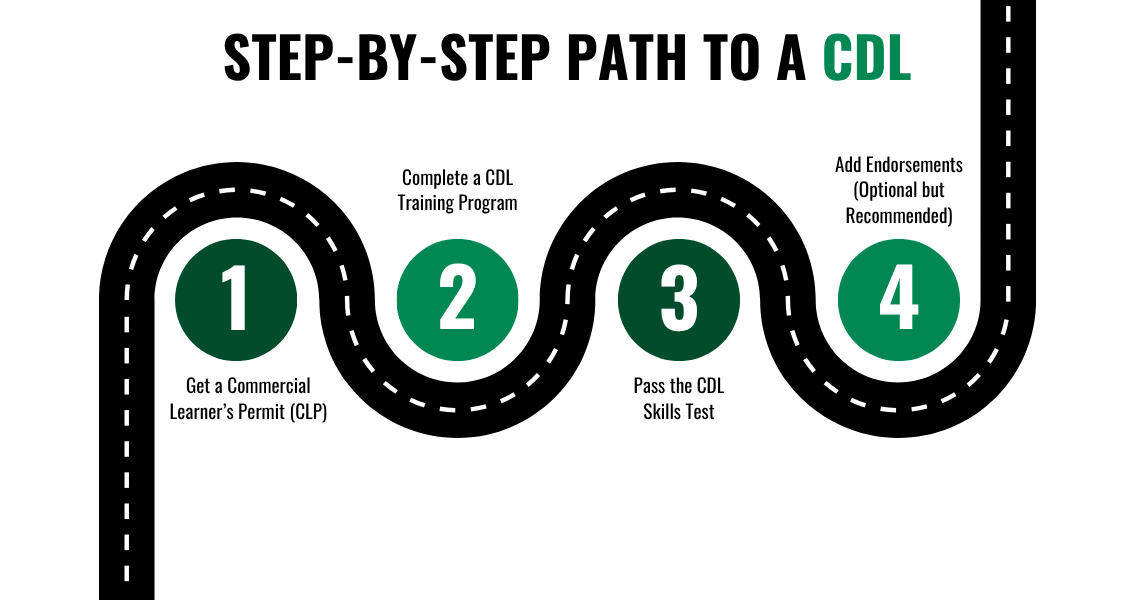
Step 1: Get a Commercial Learner’s Permit (CLP)
The CDL process begins with written knowledge tests covering general knowledge, air brakes, and combination vehicles. Once the permit is issued, drivers can practice on public roads under the supervision of a qualified CDL holder. The CLP must be held for at least 14 days before the skills test can be scheduled. Most CDL schools help students obtain their CLP during the first week of training.
Step 2: Complete a CDL Training Program
Quality CDL schools are registered on the FMCSA Training Provider Registry. Training programs combine classroom instruction, range practice, and supervised road driving, including mandatory Entry-Level Driver Training (ELDT) that all new CDL applicants must complete. Smaller class sizes provide more individual driving time and instructor attention.
Step 3: Pass the CDL Skills Test
The CDL skills test covers three areas:
- Pre-trip vehicle inspection
- Basic vehicle controls
- Road test
After passing, the CDL is issued, and the driver can begin pursuing employment.
Step 4: Add Endorsements (Optional but Recommended)
CDL endorsements expand job opportunities and can boost earnings by 10 to 30%. Common options:
| Endorsement | What It Covers |
| Hazmat (H) | Transporting hazardous materials |
| Tanker (N) | Liquid or gas cargo in tank vehicles |
| Passenger (P) | Carrying passengers commercially |
| School Bus (S) | Transporting school-age children |
| Doubles/Triples (T) | Pulling double or triple trailers |
Landing Your First Driving Job
What to Expect When Starting Out
Major carriers actively recruit new CDL graduates. Many have established hiring relationships with CDL schools and send recruiters to meet graduates directly.
Most schools have dedicated job placement services to help you write a resume, develop interview skills, apply for jobs, and speak with recruiters on campus to help you land that first job.
Route Types
Carriers offer a range of route types, each with different home time and pay structures. Most carriers offer some combination of local, regional, or over-the-road routes.
| Route Type | Coverage | Home Time | Best For |
| Local | Up to ~200 miles | Home every night | Steady routine; good for families |
| Regional | ~1,000 miles, several states | Home most weekends | Balance of earnings and home time |
| OTR | Nationwide | Out 3-4 weeks; longer break | Highest per-mile rates |
First-Year Realities
Every career change has a first year, and trucking is no different. New drivers navigate unfamiliar routes, company procedures, and strict delivery schedules. Managing time away from home and adjusting sleep schedules takes time. The adjustment period is real, but it is also temporary. As experience grows and a driver builds a reliable track record, the work becomes more predictable, and the options expand.
Taking the First Step
Trucking offers something that is hard to find in most fields: a clear, short path from decision to employment. The requirements are manageable, the training is structured, and the industry has more open positions than it can fill. For anyone stuck in a job with no room to grow, it is worth a serious look.
Frequently Asked Questions
Do I need a perfect driving record to get a CDL?
No, a perfect record is not required, but driving history matters. States check records for the past 10 years across all 50 states, and most employers will not hire drivers with serious violations such as DUIs, reckless driving, or a suspended license within that window. The best approach for anyone with concerns is to discuss them directly with the school’s admissions team.
Is truck driving a good career for someone with a family?
Yes, depending on the route type. Local and regional driving are well-suited to family life: local drivers are home every night, and regional drivers typically have weekends at home. Over-the-road (OTR) driving involves longer stretches away, often three to four weeks at a time, which requires more planning and communication at home. Many drivers start in OTR and transition to local or regional routes once they have experience. The flexibility to make that shift is one of the things that makes trucking work for people at different stages of family life.
Is truck driving physically demanding?
Truck driving does not involve heavy lifting, repetitive physical motion, or exposure to the elements, making it a significant physical relief for people coming from factory, construction, or warehouse work. Long-haul driving does come with challenges, but most people changing careers from physically demanding work describe the experience as considerably easier on the body than what they left behind.