Autonomous trucks are already hauling freight in Texas. If you’re weighing CDL training, it’s fair to ask whether that changes the value of a Class A CDL. Companies like Kodiak and Torc (a Daimler Truck subsidiary) are also running real trucks on real highways. Before you decide whether a CDL still makes sense, it helps to know what these trucks can and can’t do right now.
Key Takeaways
- Every autonomous truck running commercial freight today is Level 4. That means it only drives on fixed highway routes in clear weather. No company has a Level 5 truck on the road.
- There are no federal safety rules yet for driverless trucks. Writing those rules takes years, and the 35 states that allow testing don’t agree on how it should work.
- The trucking industry is short more than 80,000 drivers. McKinsey expects that number to double by 2030. Carriers are hiring CDL holders right now.
- Autonomous trucks can’t handle last-mile delivery, city driving, hazmat loads, construction zones, or talking to customers. Those jobs still need a person.
- New jobs like remote truck monitors, AV safety drivers, and last-mile specialists are showing up. A Class A CDL is the entry ticket for both classic driving jobs and these new tech-adjacent ones.
- Endorsements like hazmat, tanker, and doubles/triples cover loads that will be some of the last ones automated. Earning them now protects your career for longer.
A CDL earned in 2026 sets you up for decades of work. Most of the country still requires a human driver by law, and that isn’t changing soon.
Where Autonomous Trucks Actually Stand in 2025-2026
SAE Levels of Driving Automation: Level 3, Level 4, and Level 5 Explained
The Society of Automotive Engineers (SAE) lays out six levels of driving automation. Three of them matter for trucking:
| SAE Level | What It Means | Human Role |
| Level 3 | The system drives in certain conditions, but a person must be ready to take over | Driver stays on standby |
| Level 4 | The system handles all driving inside a set area or route | No driver needed in that zone |
| Level 5 | Full automation in any condition | None needed |
Every autonomous truck running commercial freight today is Level 4. No company has shown a Level 5 truck working commercially.
Aurora in Texas, Daimler Truck’s Investment, and What They Actually Cover
Aurora Innovation added a second driverless route in Texas. It runs 600 miles between Fort Worth and El Paso, launched six months after its Dallas-to-Houston route. The company has now passed 100,000 driverless miles on public roads, with five driverless trucks delivering customer freight on a regular schedule.
Daimler Truck, a company based in Germany, is investing in this technology through its subsidiary, Torc Robotics. The company expects autonomous driving to bring in more than €3 billion in revenue by 2030. Daimler Truck and Torc plan to bring SAE Level 4 trucks to the U.S. market by 2027, covering highway hub-to-hub runs only.
Why Level 4 Trucks Still Only Run Fixed Highway Routes in Good Weather
Aurora says its next round of hardware will handle all-weather driving with better sensor cleaning. That hardware is still being tested, and full production isn’t expected until 2027.
Level 4 trucks drive set interstate routes in good conditions. They can’t handle city streets, tricky intersections, or heavy snow and ice. The technology keeps improving, but the rules haven’t caught up, and that gap is slowing down wider use.
Federal and State Rules Are Still Years Away From Allowing Fully Driverless Trucks
“None of us in the automobile or IT industries are close to achieving true Level 5 autonomy. We are not even close.”
— Gill Pratt, CEO of the Toyota Research Institute
Autonomous trucks run in a few corridors today, but a mix of federal and state rules controls where they can go. That patchwork of rules is one of the biggest reasons full driverless trucking is still far off.
No unified federal safety rules exist for autonomous trucks yet. The Federal Motor Carrier Safety Administration (FMCSA) is still in the early stages of updating its rules. It asked the public which safety regulations “may need to be amended, revised, or eliminated” to safely allow autonomous trucks. In short, FMCSA is still asking questions, not writing rules.
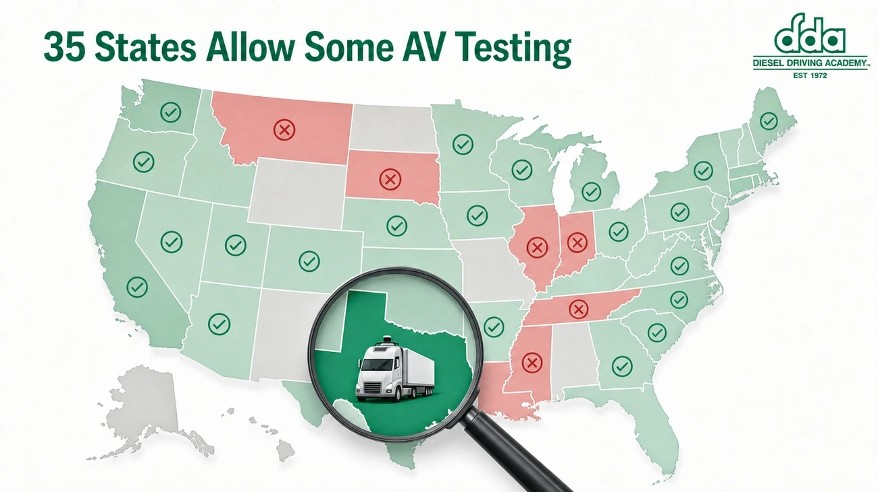
A bill in Congress (Rep. Fong’s AV trucking provisions in the BUILD America 250 Act) would push FMCSA to update its rules by 2027, but it hasn’t passed yet. Right now, 35 states allow some kind of autonomous truck testing. Other states have stricter or conflicting rules.
States don’t agree on the rules, either. Colorado passed a bill that would have required a CDL holder to be in any truck running an automated driving system and ready to step in if needed. The bill set fines of $1,000 for a first offense and $2,000 for a second. The governor vetoed it, but lawmakers pushing for it shows real pushback against driverless trucks.
For anyone thinking about a CDL in 2026, this means federal safety rules for driverless trucks don’t exist yet, and writing them takes years. Human drivers will keep being a legal requirement across most of the country for a long time.
The Driver Shortage Is Still Growing, and Carriers Are Still Hiring
Rules are slowing autonomous trucks down. Meanwhile, the driver shortage keeps growing.
More Than 80,000 Drivers Short, and McKinsey Says It Will Double by 2030
The American Trucking Associations (ATA) reports a shortage of more than 80,000 drivers, and that number hasn’t turned around. McKinsey’s research points to the same shortage and expects it to double by 2030. The ATA also projects the industry will need 1.1 million new drivers over the next decade. That’s about 110,000 a year, just to replace retiring drivers and keep up with growth.
Why an Aging Workforce and High Turnover Keep Demand Strong
The average truck driver in the U.S. is 47 years old, and retirements are accelerating. Women make up only 4.1% of truck drivers. These numbers show the shortage isn’t a short-term blip. It’s built into the structure of the industry.
How Schools With Carrier Relationships Get Graduates Hired Now
Schools with real carrier hiring relationships can connect graduates directly to jobs. DDA has trained CDL drivers for more than 50 years. In that time, plenty of new technology has come and gone, from CB radios to electronic logging devices (ELDs) to autonomous trucks. Carrier partners like Stevens Transport, Werner Enterprises, TMC Transportation, and Schneider still hire DDA graduates. That track record answers the worry that the jobs won’t be there.
High demand explains why jobs are open. What autonomous trucks still can’t do explains why they’ll stay open.
Autonomous Trucks Cannot Handle Most Real-World Trucking Work
That’s a narrow slice of what trucking really involves.
Last-Mile Delivery, City Driving, Tight Backing, and Talking to Customers
Researchers at UC Berkeley’s Labor Center expect it will take decades before driverless trucks can handle local streets full of cars, pedestrians, cyclists, and road work. Humans are also needed to hook up tractors and trailers, fuel the truck, do inspections, fill out paperwork, talk with customers, and load and unload freight.
A 30-year trucking veteran put it this way in a USA Today column: “A machine can drive a truck on the turnpike or some other controlled environment,” but “good outcomes in the most critical moments still depend on an experienced human operator making the right decisions.”
Weather, Construction Zones, Hazmat Loads, and Oversized Hauling
Cost is also a factor. Trucking companies aren’t eager to spend money on technology that might not work well in snow, ice, or fog. Hazmat loads, oversized hauling, and construction zones all call for human judgment that today’s autonomous systems don’t have.
The Airline Autopilot Comparison
Aviation offers a useful comparison. Modern planes already use AI for maintenance checks, navigation, and spotting potential conflicts. Even so, the pilot’s role as the final decision-maker becomes more important, not less, as that AI gets better. Trucking looks to be heading the same way. Future drivers may spend part of their time monitoring an automated system instead of gripping the wheel the whole time.
Safety and Liability Questions That Keep Humans in the Cab
Who’s responsible when an autonomous truck from one company is involved in a crash with a truck from another? That’s still an open question. Until the legal side catches up, carriers have good reason to keep trained drivers in the cab.
These same limits are creating new jobs that still require a CDL to get started.
New Roles Are Emerging That Require a CDL as the Entry Credential
“Human drivers would take care of non-driving tasks and navigate complicated local streets, then swap trailers with self-driving trucks at an autonomous truck port (ATP) next to the highway.”
— Steve Viscelli, Sociologist, University of Pennsylvania
As autonomous trucking grows, carriers and logistics companies need people who understand both the freight side and the tech side. Those jobs are being built right now, and they all start with the same requirement: a CDL.
Remote Truck Monitors, Fleet Coordinators, and AV Safety Drivers ($55K-$85K)
The most likely setup has local drivers bringing trailers to “autonomous truck ports” outside cities, where the trailers get swapped onto autonomous tractors for the highway leg. The process runs in reverse on the other end. That setup creates jobs for remote monitors, fleet coordinators, and AV safety drivers. Programs like Pima Community College’s autonomous vehicle operations certificate are already training people for roles like Autonomous Truck Test Driver and Autonomous Vehicle Operations Specialist. These roles typically pay between $55,000 and $85,000.
First-Mile and Last-Mile Specialists Fill the Gaps Autonomous Trucks Can’t
Automation should bring long-haul costs down, and customers still expect fast delivery. Together, those trends should increase the need for local drivers who move loads to and from autonomous truck ports and get goods to customers’ doors.
Why a Class A CDL Sets You Up for Both Paths
You can earn a Class A CDL through programs that range from a 3-week exam prep course to 20 weeks of hands-on training. That credential works for both classic driving careers and the new tech-adjacent roles. Either way, the CDL is the starting point.
The next step is making sure that CDL is positioned to reach these roles for the long run.
How to Future-Proof a CDL Career Starting Now
A CDL earned in 2026 opens more than one career path. How you build on it, through endorsements, specializations, and technical skills, decides how well that career holds up as the industry changes.
Earn a Class A CDL First
A Class A CDL is still the baseline credential for almost every job in commercial trucking, automated or not. Completing entry-level driver training at an school that is compliant is the first step in the process. Learning the rules of the road and getting comfortable behind the wheel. This is the foundation for any successful CDL-holder, and can be completed in a short period of time.
Add Endorsements Autonomous Trucks Can’t Touch: Hazmat, Tanker, Doubles/Triples
A standard Class A license covers dry van freight. Moving from around $55,000 up to $80,000 or more usually means adding endorsements. Hazmat, tanker, and doubles/triples endorsements open the door to specialized loads, and those loads will likely be among the last ones automated because of safety and regulatory hurdles. DDA offers Hazmat Endorsement Training as an add-on to Class A CDL training.
Get Comfortable With ELDs, GPS, and Digital Fleet Tools
Electronic Logging Devices (ELDs) connect to a truck’s engine and record driving time automatically, which makes hours-of-service logs more accurate. Drivers who are already comfortable with ELDs, GPS routing, and digital fleet tools will have an easier time moving into tech-adjacent roles as they open up.
Focus on the Work AVs Won’t Touch: Local Delivery, Specialized Hauling, and Construction
Logistics work today goes beyond moving freight from point A to point B. On jobs like data center construction, drivers and logistics crews help with installation, handle sensitive loads, and keep build schedules on track. Work like this needs human judgment, a physical presence, and direct customer contact, things autonomous systems can’t offer.
The Investment Calculation: Program Cost vs. 20-30 Years of Career Runway
The roles opening up around autonomous trucking, from remote monitoring to fleet coordination, are the kind of growth that tends to create jobs rather than cut them. Measured against 20 to 30 years of career runway across both traditional and emerging roles, DDA’s tuition is a solid trade.
Drivers who start now have time to build endorsements and specializations before autonomous trucks reach wider use. DDA connects graduates with carriers that are actively hiring, both for traditional driving roles and the emerging tech-adjacent positions covered above. Talk to an admissions rep about programs, schedules, and what to expect on day one.
FAQs
Which trucking jobs are most at risk from automation?
Long-haul highway routes carry the most near-term risk, since that’s the only setting autonomous trucks can currently handle. Local delivery, hazmat hauling, oversized loads, and any driving involving city streets or customer contact are not at risk right now.
Can autonomous trucks handle situations that need human judgment, like unbalanced cargo or a dangerous driver nearby?
No. Today’s systems can’t manage tasks like coupling trailers, fueling, inspections, or customer communication.
Which states allow driverless freight trucks?
About 35 states currently allow some form of autonomous truck testing or use, but the rules vary widely from state to state. There’s no federal safety standard yet, so each state sets its own approach.
How can truck drivers stay competitive as the technology advances?
Drivers can build their skill set with endorsements like hazmat, tanker, and doubles/triples, and get comfortable with ELDs, GPS routing, and digital fleet tools. Both make it easier to move into new tech-adjacent roles as they open up.
Are CDL drivers still in high demand?
Yes. Carriers are actively hiring CDL holders to close a well-documented driver shortage that isn’t going away anytime soon.