CDL training at Diesel Driving Academy (DDA) takes 3 to 30 weeks, depending on the program and schedule a student chooses. Night classes take 8 weeks for the Basic training program and 30 weeks for the Advanced program.
Time in class is only part of the picture, though. Before earning a Class A CDL, every new driver must pass a DOT medical exam, hold a learner’s permit for at least 14 days, and pass a three-part skills test. After that, most carriers add a few weeks of paid training on the job. Knowing each step ahead of time helps students plan their finances, avoid delays, and choose the program that fits their goals.
This guide explains how DDA’s programs work, what federal rules require, and what can speed up or slow down the path from the first day of class to the first trucking job.
How Long Is CDL Training at DDA?
DDA offers Class A CDL training with programs that range from 3 to 30 weeks. Shorter programs get students ready for an entry-level job quickly. Longer programs give deeper preparation for complex work.
The right program depends on a student’s goals, schedule, and budget. DDA’s admissions team helps each student pick a path, so students do not need to decide on a program before they reach out.
Night Class Options
DDA offers day classes and night CDL classes at its Shreveport and Baton Rouge campuses. Night classes let working adults train without quitting their current jobs.
DDA’s night class programs take:
- Basic training program: 8 weeks
- Advanced program: 30 weeks
Night classes meet for fewer hours each day than day classes, so the same training covers more weeks on the calendar. The Advanced program adds more practice time for drivers who want to prepare for long-haul and OTR work. DDA also has tips for balancing CDL training with work and family.
Campus Locations
DDA trains new drivers at three Louisiana locations:
- Baton Rouge
- Shreveport
- Monroe (an affiliate of the Baton Rouge campus)
No prior trucking experience is needed to start.
Federal Training Rules: What ELDT Requires
Since 2022, the Federal Motor Carrier Safety Administration (FMCSA) has required Entry-Level Driver Training, called ELDT. Anyone getting a Class A CDL for the first time must finish ELDT before taking the CDL skills test. The training must come from a school or company listed on the FMCSA Training Provider Registry.
ELDT has two parts:
- Theory training: Classroom lessons on required topics, such as vehicle systems, hours of service, and safe driving. Students must score at least 80 percent overall on the theory assessment.
- Behind-the-wheel training: Hands-on driving on a practice range and on public roads. The instructor must see that each student can do every required skill well.
ELDT rules set no minimum number of hours for theory or behind-the-wheel training. Instead, training is based on skill. A student finishes when they have covered every topic and shown they can drive safely. This is one reason program lengths differ.
After a student finishes, the training provider must report it to the Training Provider Registry by midnight of the second business day. The state then checks the registry before it allows the student to take the skills test.
All DDA programs are ELDT-compliant and FMCSA-registered.
How Long It Takes to Get a CDL After Training Starts
Most of the steps to a CDL happen during training, not after it. Before getting a permit, each student must pass a DOT physical and receive a medical card. DDA then helps students get their commercial learner’s permit (CLP) during the first week of training.
Federal rules require a student to hold a CLP for at least 14 days before taking the CDL skills test. Louisiana’s Office of Motor Vehicles (OMV) follows this rule. Since DDA students get their permit in the first week, most of this wait happens while they are still in class.
Once training is complete, students take the Louisiana CDL skills test with an OMV-approved third-party tester. The test covers a pre-trip inspection, basic control skills like backing, and an on-road drive. After passing, the driver returns to the OMV to be issued a Class A CDL.
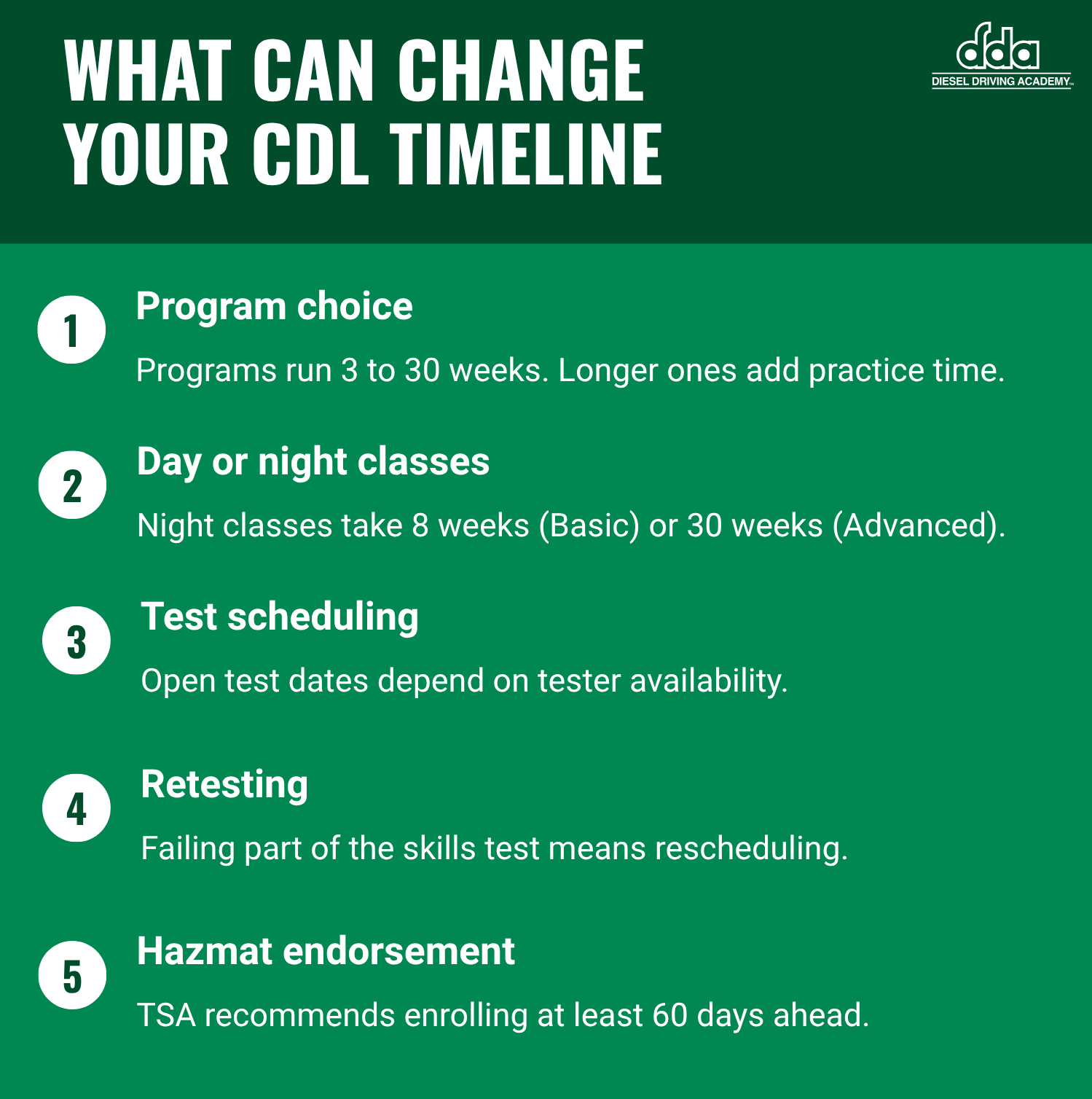
What Can Change the Timeline
Several things can make the path to a CDL shorter or longer:
- Program choice: DDA programs range from 3 to 30 weeks. A longer program adds time but gives more practice.
- Day or night classes: Night classes take 8 weeks for the Basic training program and 30 weeks for the Advanced program, because they meet for fewer hours each day.
- Skills test scheduling: Open test dates depend on tester availability. Scheduling early helps avoid gaps after training.
- Retesting: A student who fails part of the skills test must reschedule, which adds time.
- Medical issues: A health condition that needs extra paperwork or follow-up can slow down the medical card.
- Hazmat endorsement: Drivers who add a hazmat endorsement need a Transportation Security Administration (TSA) background check with fingerprints. TSA recommends enrolling at least 60 days before the endorsement is needed. DDA offers Hazmat endorsement training that students can add to their Class A program, and its hazmat endorsement guide covers the full process.
- Paying for school: Financial aid paperwork takes time. DDA’s financial aid team helps students with federal grants, loans, WIOA funding, and VA benefits for veterans before training starts.
What Comes After CDL Training
Most new drivers do not drive alone as soon as they finish training. Many carriers first run hiring checks and then hold paid orientation and training with an experienced driver.
DDA’s job placement team connects graduates with local and national carriers that are hiring, including partners like Werner Enterprises. DDA offers lifetime job placement help, on-campus hiring events, resume help, and interview prep. Graduates go on to OTR, regional, local, and owner operator jobs.
Students with questions about program length can contact DDA’s admissions team to compare options.
Frequently Asked Questions
Is Class B CDL training shorter than Class A training?
Yes. Class B training is usually shorter because it covers single trucks, not tractor-trailers, but DDA does not offer Class B training and focuses only on Class A CDL programs.
Can an experienced driver test out of ELDT behind-the-wheel training?
No. Federal ELDT rules do not allow students to test out of behind-the-wheel training, so every first-time Class A applicant must show each skill to a registered instructor.
Can ELDT theory training be done online?
Yes. Theory training can be taught online or in a classroom by a registered provider, but behind-the-wheel training must happen in person in a real truck. However, DDA offers its theory training exclusively in person.
How long is a commercial learner’s permit valid?
A CLP can be valid for up to one year from the date it is first issued. A student who does not get a CDL within that year must retake the knowledge tests.
Can an 18-year-old get a CDL?
Yes, but only for driving within one state, since federal rules require drivers to be 21 to haul freight across state lines. DDA students must be at least 21 by graduation.