Finishing CDL training is a big step, but a new driver still has a few steps left before running a load alone. First, the student passes the CDL skills test. Then each trucking company checks the driver’s record, orders a drug test, and runs a Clearinghouse check. After that, the driver goes through paid orientation and training with an experienced driver. This guide walks through each step for Diesel Driving Academy graduates.
Key Takeaways
- A CDL makes a graduate eligible to apply at trucking companies. Each company still runs its own hiring checks.
- Hiring checks include a driving record review, a DOT physical, a drug test, and a Clearinghouse check.
- Paid orientation and training usually last three to seven weeks, depending on the carrier.
- Some requirements continue after hire, such as medical card renewal and yearly Clearinghouse checks.
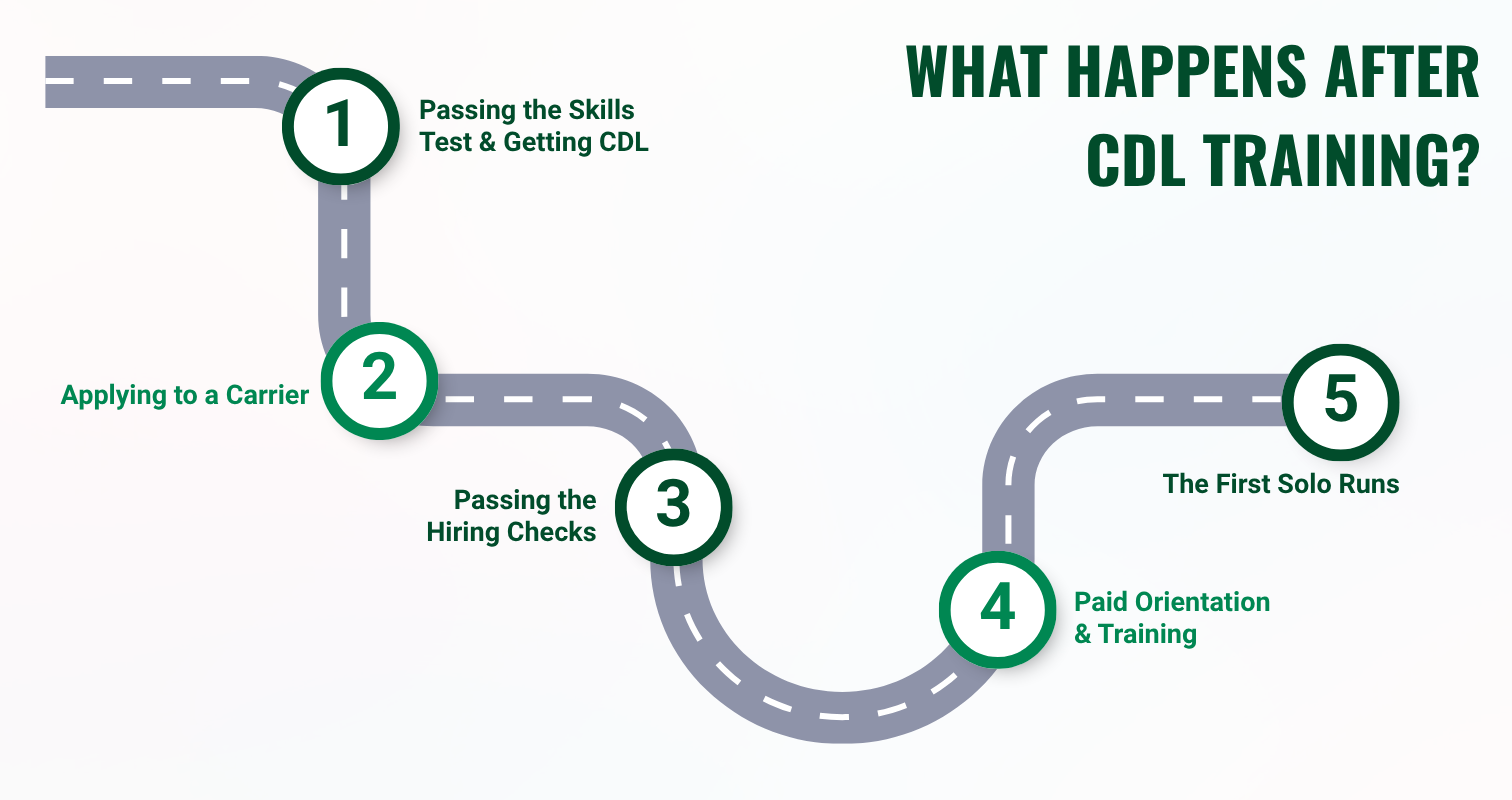
Step One: Passing the Skills Test and Getting the CDL
Federal rules require first-time Class A drivers to finish Entry-Level Driver Training (ELDT) before the skills test. When a student finishes, the school reports it to the FMCSA Training Provider Registry.
A student must hold a Commercial Learner’s Permit (CLP) for at least 14 days before taking the skills test. In Louisiana, the test is given by an OMV-approved third-party tester. It has three parts: a pre-trip inspection, basic vehicle control, and an on-road drive. After passing, the driver gets the CDL from the Louisiana Office of Motor Vehicles.
Step Two: Applying to a Carrier
A graduate applies directly to a trucking company. Many students start this step before they finish CDL training. DDA’s job placement team connects students and graduates with carriers that are hiring, such as Stevens Transport, TMC Transportation, Schneider, and Werner Enterprises. Some carriers make a conditional job offer first. The hiring checks come after that offer.
Step Three: Passing the Hiring Checks
Federal rules set the checks every carrier must run. Each carrier can also add its own standards on top of them.
Driving record and work history
The carrier reviews the driver’s motor vehicle record (MVR) for the past three years. It also checks safety records from any past employers who hired drivers under DOT rules. Some carriers set stricter limits. TMC, for example, allows no more than three moving violations in five years and no DUI in the last ten years.
DOT physical
The driver must pass a DOT physical from a medical examiner listed on the FMCSA National Registry. A medical card lasts up to 24 months, but an examiner can issue a shorter card based on the driver’s health. DDA explains more about why health matters for a CDL.
Drug test
The person applying for the job needs to have a negative drug test result before the new hire can drive a commercial truck.
Clearinghouse check
The FMCSA Drug and Alcohol Clearinghouse is a database of driver drug and alcohol violations. Before hiring, the carrier must search it with the driver’s consent. The driver gives that consent online through a Clearinghouse account.
Step Four: Paid Orientation and Training
No federal rule sets how long orientation lasts, so each carrier sets its own schedule. Most carriers pay new drivers during this time, but pay and length vary by company.
Orientation usually starts with classroom time. New drivers learn company rules, safety policies, equipment, and paperwork. After that, most carriers pair the new driver with an experienced trainer on the road. The trainer rides along while the new driver handles real loads, plans trips, and follows hours-of-service rules. The training stage ends when the trainer signs off that the driver is ready to run alone.
Graduates should ask each carrier during the hiring process how long orientation and training last and how pay works. DDA’s job placement team can help graduates compare carriers.
Step Five: The First Solo Runs
Once the trainer signs off, the new driver gets a truck and runs loads alone. First jobs may be local, regional, dedicated, or over-the-road (OTR). The route depends on the carrier’s needs and the driver’s preference. Many carriers also assign a coach who checks in during the first weeks of solo driving. DDA’s post on the first year as a truck driver covers what that year is like.
What Do New Truck Drivers Earn?
The Bureau of Labor Statistics (BLS) reports a median yearly wage of $58,640 for heavy and tractor-trailer truck drivers across the country as of May 2025. The lowest 10 percent earned under $40,140, and the top 10 percent earned over $79,380.
Carriers advertise different pay depending on the route, freight type, and customer. Graduates should compare pay details during the hiring process.
What Requirements Continue After Hire?
A CDL comes with rules that last as long as the driver works in trucking:
- Medical card renewal: A driver must renew the DOT medical card before it expires. If the card expires, the state can downgrade the CDL until a new one is on file.
- Yearly Clearinghouse check: The carrier must search the Clearinghouse for each driver at least once a year.
- Ongoing drug testing: Drivers can be tested at random, after an accident, or when a supervisor has a reason to suspect drug use.
Adding endorsements
Drivers can add endorsements to qualify for more types of jobs. The six endorsements are:
- T (doubles and triples)
- N (tank vehicles)
- H (hazardous materials)
- X (tank and hazardous materials combined)
- P (passenger)
- S (school bus)
First-time H, P, and S applicants must complete ELDT for that endorsement. HAZMAT applicants also need a TSA security check. DDA offers Hazmat endorsement training for drivers who want to add it.
Frequently Asked Questions
Does a new driver need to register for the Clearinghouse?
Yes. A driver needs a Clearinghouse account to give online consent for a carrier’s pre-hire check.
Can a driver with a speeding ticket still get hired?
Often, yes. Each carrier sets its own limits on moving violations, so the answer depends on the company.
What happens if a new hire fails the pre-employment drug test?
The carrier cannot let the driver operate a commercial truck, and the result goes into the Clearinghouse. The driver must finish a return-to-duty process with a substance abuse professional before driving for any carrier.
What should a new driver bring to orientation?
Most carriers ask for the CDL, the DOT medical card, and ID for hiring paperwork. Each carrier sends its own checklist before orientation starts.
Can a student apply to carriers before finishing training?
Yes. Many carriers accept applications from students, and DDA’s job placement team starts working with students before graduation.
Can DDA help a graduate find a new job after the first carrier?
Yes. DDA’s job placement team helps graduates look for new driving jobs after their first position. DDA also covers what to do if the first carrier isn’t a good fit.
Students and graduates with questions about testing, hiring, or next steps can contact DDA to speak with the admissions or job placement team.